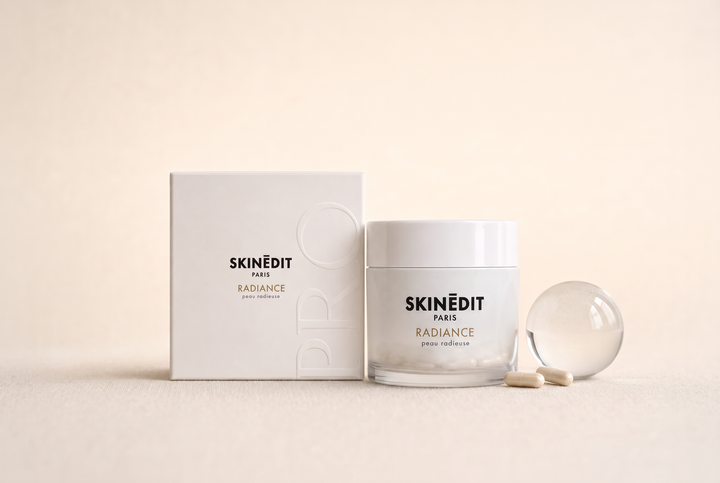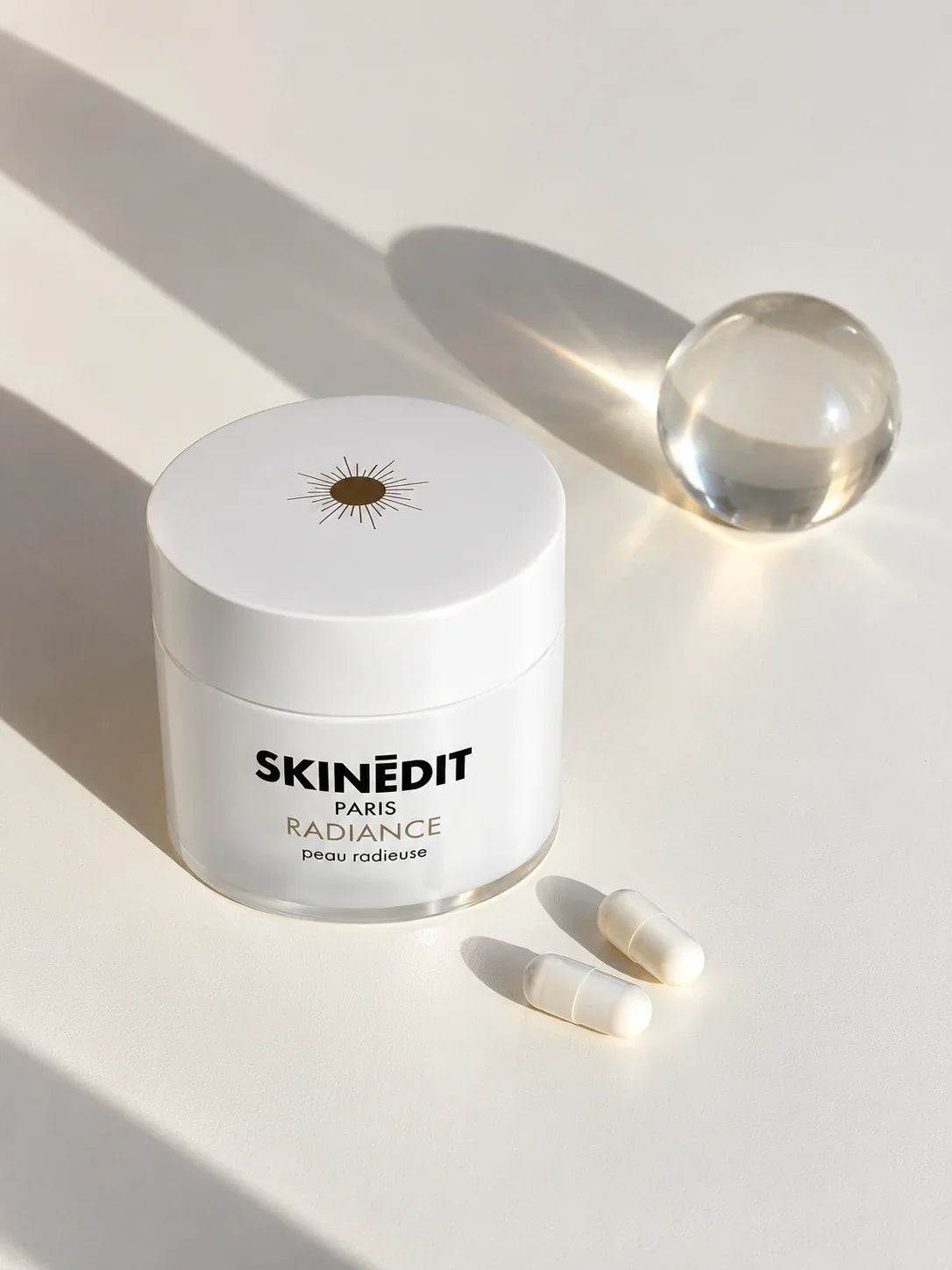
A more even-looking complexion starts with a focused routine. Choose a serum suited to your dark spots and skin sensitivity, alongside daily sun protection. For an oral approach, RADIANCE brings together BELIGHT³™, studied in humans for complexion evenness, and liposomal glutathione among its ingredients. Here is how to choose the steps in your ritual.
The most useful question at the beauty counter is rarely “Which bottle is strongest?” It is “What am I asking this formula to do?” A lingering blemish mark, an uneven-looking complexion and a patch of melasma can lead you towards the same shelf, while requiring different decisions.
This guide is a buying framework: how to read a serum claim, avoid an overloaded routine and decide whether an inside-out step deserves a place beside your topical care.
Before buying: define the change you want to see
Choose one priority you can describe clearly. “The brown mark left by last month’s blemish” is more useful than “better skin”. If the concern is broader facial patches, read our melasma evidence guide and seek an individual assessment. If a spot is new, changing or bleeding, have it examined before trying to fade it.
Also distinguish colour from texture. A moisturising formula may make skin look fresher without changing a particular pigmented mark. If you want dark-spot improvement, look for an assessment of pigmentation rather than hydration alone.
Which serum ingredients are worth comparing?
Vitamin C: check the form as well as the percentage
Vitamin C appears in several forms, including L-ascorbic acid and derivatives. Formulation, stability and delivery influence performance. A high percentage is not a substitute for evidence on the actual serum. Our vitamin C and dark-spot guide examines the human studies and their limits. [1]
Niacinamide: read beyond the ingredient's reputation
A controlled 12-week study of a moisturiser with 5% niacinamide in 50 women reported improvements in visible ageing signs, including pigmented spots. That supports a specific tested formulation, not an assumption that every niacinamide serum will behave identically. Ask whether the product offers finished-formula data rather than borrowing an ingredient study. [2]
Retinoids or azelaic acid: consider the whole skin picture
These are among the topical options discussed in dermatology guidance for pigmentation. A clinician can help choose an appropriate formulation if you also have acne, significant sensitivity or persistent patches. Retinoids can irritate and should not be used during pregnancy. Do not add a cosmetic serum on top of prescribed care without checking how it fits. [3] [4]
Five questions that make a serum claim useful
- Was this exact formula tested? An ingredient, a prototype and the bottle you are buying are three different things.
- What improved? Spot contrast, spot area, overall tone and a participant’s impression of “glow” are different outcomes.
- Compared with what? A controlled comparison is more informative than before-and-after photographs alone.
- Who completed the study? Look for the number of participants, their skin characteristics and the condition assessed.
- What else did they use? Sunscreen, prescription treatment or a procedure can influence the result. A combined routine cannot prove what the serum would do alone.
Keep the claims in proportion. “80% of participants agreed their skin looked brighter” would describe an opinion survey; it would not mean dark spots fell by 80%. A well-written product page should make that distinction easy to see.
Build the routine before adding another active
Morning: gentle cleansing if needed, your chosen serum according to its directions, moisturiser if needed and sunscreen as the final skincare step. Choose broad-spectrum, water-resistant SPF 30 or higher; reapply outdoors about every two hours and after swimming or sweating. For pigmentation concerns, a suitable iron-oxide tint adds visible-light protection. [3] [5]
Evening: cleanse gently, use the chosen treatment at its recommended frequency and moisturise. The serum does not have to be used twice daily unless its directions say so. Avoid starting several new actives together: you will have fewer clues about the cause if discomfort appears.
Persistent burning, peeling or redness calls for reassessment, not an extra layer of “brightening” care. Stop an irritating non-prescription cosmetic; contact your prescriber about reactions to prescribed treatment. For another route through the decision, read retinol and sensitive skin.
RADIANCE: complexion care from within
RADIANCE combines BELIGHT³™, liposomal glutathione and other selected actives in an oral complexion formula. Two capsules with a meal create a daily ritual without another active to apply to your skin.

An ingredient studied for complexion evenness. In a 12-week BELIGHT³™ study, 72% of the active group showed improved complexion evenness, compared with 23% of the placebo group. The analysis included 31 active-group participants taking 300 mg of BELIGHT³™ daily. These findings concern the studied ingredient, not the finished RADIANCE formula. Read the BELIGHT³™ study.
Keep daily sun protection and prescribed skincare in place. Follow the label and seek professional advice during pregnancy or breastfeeding, with medication or with a health condition. Food supplements do not replace a varied, balanced diet or a healthy lifestyle.
Discover the RADIANCE ritual
Explore its composition, ingredient research and daily directions to choose your complexion protocol.
How to judge whether your routine is worth continuing
Make a simple record before changing anything: your priority, current products, any irritation and a photograph in neutral light. Compare later images under similar conditions, without filters. Note changes in sun exposure and treatment.
Agree a review point that fits the product’s evidence or your clinician’s advice. A 12-week study is not a promise that every mark clears in 12 weeks. If you introduce a serum and supplement together, your observations cannot tell you which caused a change. A comfortable, manageable routine is easier to evaluate than a continually expanding one.
Frequently asked questions
Can I use a dark-spot serum without sunscreen?
Sun protection remains a core step. A serum does not provide the labelled UV protection of a sunscreen. Pair it with shade and protective clothing when outdoors.
Is a stronger serum always better?
No. Compare the complete formulation, evidence and tolerance. Percentage alone cannot predict performance across different ingredients or vitamin C forms.
Do I need both a serum and an oral supplement?
No. An oral step is optional. Start with the concern, your existing treatment and product-specific evidence rather than assuming a more complicated routine gives a better result.
Can RADIANCE replace my dark-spot treatment?
That equivalence has not been established. RADIANCE is a food supplement, and a prescribed treatment should not be replaced without advice from your clinician.
Sources
- Al-Niaimi and Chiang. Topical Vitamin C and the Skin. Journal of Clinical and Aesthetic Dermatology, 2017.
- Bissett et al. Niacinamide: a B vitamin that improves aging facial skin appearance. Dermatologic Surgery, 2005.
- American Academy of Dermatology: How to fade dark spots in darker skin tones.
- American Academy of Dermatology: Retinoid or retinol?
- American Academy of Dermatology: Practice Safe Sun.
Written by SKINĒDIT PARIS, the maker of RADIANCE. This guide offers general information, not an individual diagnosis or a promise of results.