Vitamin C is a useful starting point for understanding skin radiance. In a serum, selected formulas have been studied for uneven tone and photoageing; in your diet, vitamin C contributes to normal collagen formation. For those seeking an oral approach to complexion care, RADIANCE offers a multi-ingredient formula built around BELIGHT³™ and liposomal glutathione. Explore what each approach brings to your routine.
“My skin looks tired” can describe several experiences: roughness, a lack of luminosity, uneven colour or a complexion that looks different under winter light. Before investing in a new serum or supplement, decide which of those you want to change.
This is a practical guide to choosing the right format, reading the bottle and keeping the routine proportionate. For the detailed pigmentation research, see our separate article on vitamin C and dark spots.
First, make “dull skin” a more precise concern
- Skin feels dry or tight: review cleansing and moisturising before escalating active ingredients.
- Colour looks uneven: identify whether you are seeing individual brown marks, wider patches or redness. These do not all need the same approach.
- The change is mainly in photographs: compare the same lighting and camera settings before deciding that a new product is necessary.
- Pallor or fatigue is new and persistent: seek medical advice rather than treating it as a cosmetic vitamin deficiency.
Use that observation to set your shopping brief. “A serum I can tolerate that helps the appearance of uneven tone” is a more useful target than “the strongest antioxidant”.
What should you look for in a vitamin C serum?
1. The form on the ingredient list
L-ascorbic acid is a well-studied form of topical vitamin C, but it is challenging to stabilise. Derivatives such as ascorbyl glucoside or sodium ascorbyl phosphate have different formulation properties. Their names cannot establish which finished product performs best on your skin. [1]
If a product simply advertises a “vitamin C complex”, ask what the percentage refers to: the vitamin itself, a derivative or a broader ingredient mixture. A percentage without that context makes comparisons less useful.
2. Evidence that matches the bottle
Look for testing on the complete formula and an outcome that matches your goal. A laboratory antioxidant assay, a hydration measurement and a clinical assessment of pigmentation answer different questions. An ingredient’s biological role is useful background; it does not establish the size of a visible effect.
3. Stability and directions
Packaging, storage instructions and the recommended period after opening deserve attention. Follow the manufacturer’s guidance on heat, light and any change in appearance. A colour change can be a reason to ask the brand about stability, but colour alone cannot measure how much active vitamin C remains.
4. A concentration you can actually use
A higher number is not automatically a better daily choice. Acidic formulations and higher concentrations may irritate some skin. A review of topical vitamin C describes the importance of formulation and the limits of simply increasing concentration. Avoid treating one percentage as a rule for every derivative. [1]
If your skin is already uncomfortable, simplify the routine and seek advice if symptoms persist. Buying a stronger serum to compensate for irregular use can leave you with the same problem in a more irritating form.
Morning or evening? Build a routine around the directions
A simple morning sequence is cleansing if needed, vitamin C serum according to its directions, moisturiser if needed and sunscreen. A serum’s antioxidant activity does not establish an SPF. Use broad-spectrum, water-resistant SPF 30 or higher, with shade and protective clothing, and reapply outdoors as directed. [2]
If the product is intended for evening use, follow that advice instead. The important point is consistent, comfortable use of the actual formula. Do not start a new vitamin C serum, retinoid and exfoliating acid on the same day just to make the routine feel complete.
If you already have prescribed skincare, ask where the serum belongs before changing it. Our guide to sensitive skin and retinol alternatives can help you frame that discussion.
What does vitamin C in food contribute?
Vitamin C is an essential nutrient involved in normal collagen formation and antioxidant functions. Useful food sources include peppers, kiwifruit, citrus fruit, strawberries and broccoli. An ordinary varied diet can provide it without turning every meal into a supplement calculation. [3]
As practical ideas, add a kiwi to breakfast, peppers to a lunch salad or broccoli to dinner. These are examples of food variety, not a prescribed “glow menu” or a promise of cosmetic change.
The nutritional question is whether intake is adequate. A serum does not replace dietary vitamin C, and extra oral vitamin C should not be assumed to reproduce a serum’s results.
Do vitamin C supplements make skin brighter?
Correcting inadequate intake and creating a visible cosmetic improvement in an adequately nourished person are different questions. Evidence on a multi-ingredient oral blend cannot isolate the effect of vitamin C alone. Likewise, evidence on topical vitamin C cannot be transferred to a tablet.
High oral intakes can cause digestive upset and may be unsuitable in some health situations. If you have kidney disease, a history of kidney stones or an iron-overload disorder, or take medication, discuss supplementation with a clinician. Review all your supplement labels rather than judging each bottle separately. [3]
RADIANCE: complexion care from within
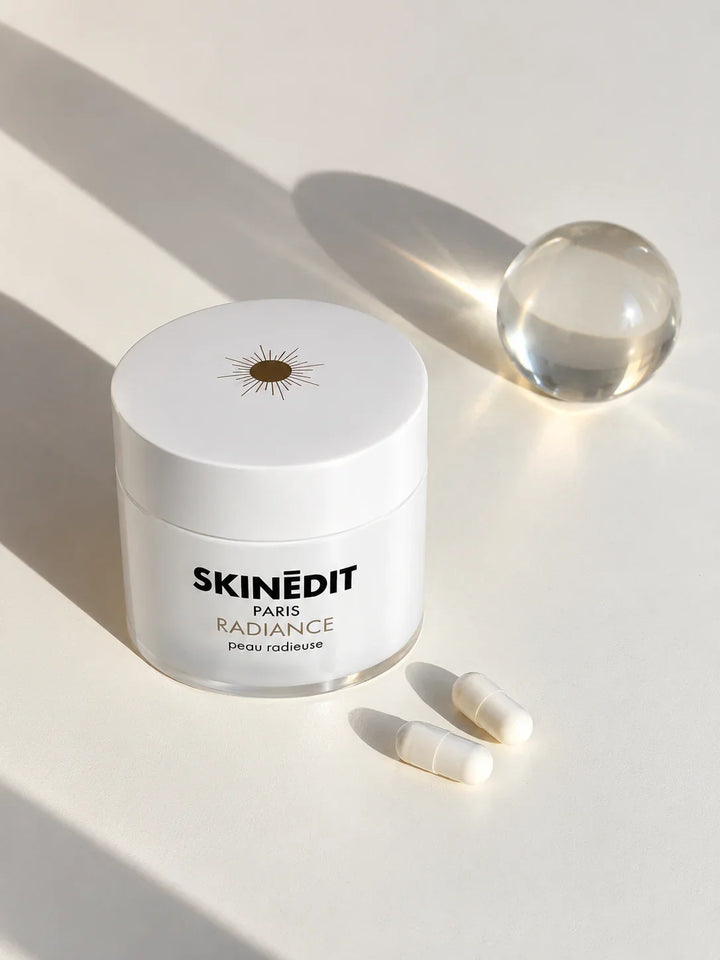
RADIANCE combines BELIGHT³™, liposomal glutathione and other selected actives in an oral complexion formula. Two capsules with a meal create a daily ritual without another active to apply to your skin.

An ingredient studied for complexion evenness. In a 12-week BELIGHT³™ study, 72% of the active group showed improved complexion evenness, compared with 23% of the placebo group. The analysis included 31 active-group participants taking 300 mg of BELIGHT³™ daily. These findings concern the studied ingredient, not the finished RADIANCE formula. Read the BELIGHT³™ study.
Keep daily sun protection and prescribed skincare in place. Follow the label and seek professional advice during pregnancy or breastfeeding, with medication or with a health condition. Food supplements do not replace a varied, balanced diet or a healthy lifestyle.
Discover the RADIANCE ritual
Explore its composition, ingredient research and daily directions to choose your complexion protocol.
Your three-question checklist
- What am I trying to change? Comfort, texture and pigmentation deserve separate attention.
- Does the evidence match the format? Food, serum, vitamin tablet and combined oral formula are not interchangeable.
- Can I keep this routine stable? Introduce one change at a time, note tolerance and compare photographs in consistent light.
For persistent dark marks rather than general dullness, our inside-out dark-spot guide provides a more targeted framework.
Frequently asked questions
Does dull skin mean I lack vitamin C?
No. Appearance alone cannot establish a nutritional deficiency. Persistent symptoms or a restricted diet are reasons to seek individual advice.
Can I use vitamin C serum every day?
Follow the directions for the formula and your skin’s tolerance. Daily use is not a requirement to push through burning or persistent irritation.
Can vitamin C replace sunscreen?
No. Neither a serum nor an oral supplement substitutes for a tested sunscreen’s UV protection.
Do I need a serum if I eat plenty of fruit?
Adequate nutrition and topical skincare serve different purposes. A serum is optional, based on your concern and its formulation-specific evidence, not a requirement created by your diet.
Sources
- Al-Niaimi and Chiang. Topical Vitamin C and the Skin. Journal of Clinical and Aesthetic Dermatology, 2017.
- American Academy of Dermatology: Practice Safe Sun.
- NIH Office of Dietary Supplements: Vitamin C fact sheet for health professionals.
Written by SKINĒDIT PARIS, the maker of RADIANCE. Ingredient studies and finished-product studies are different evidence. Food supplements do not replace a varied, balanced diet, a healthy lifestyle or appropriate medical care.