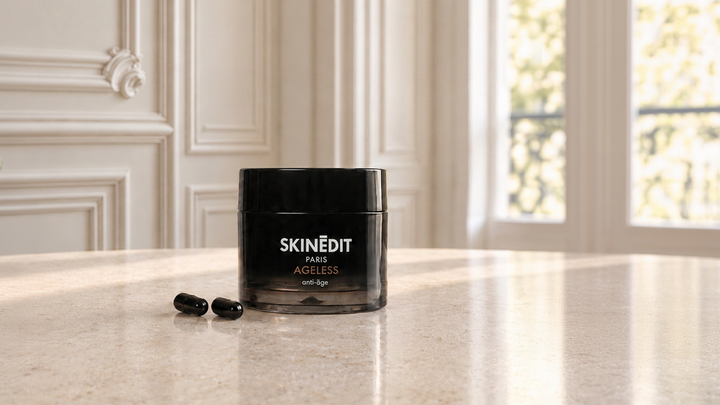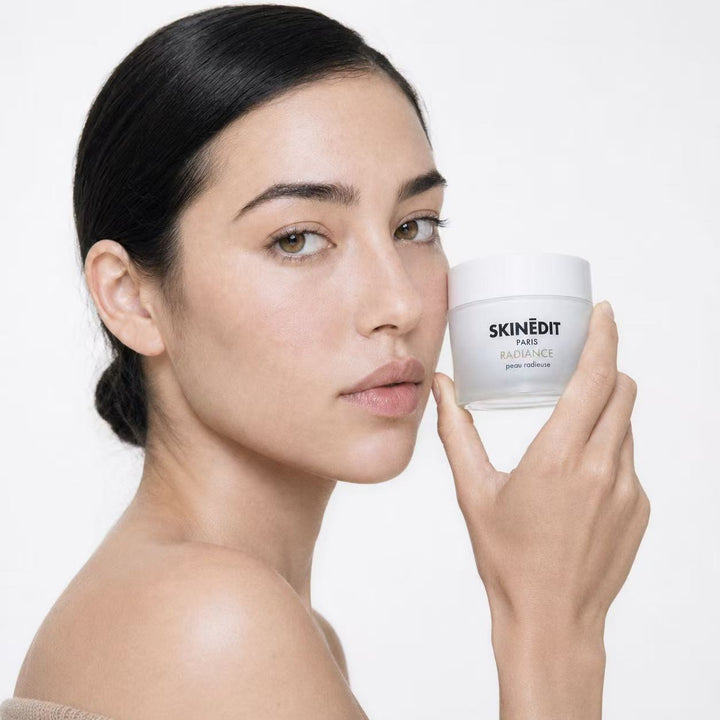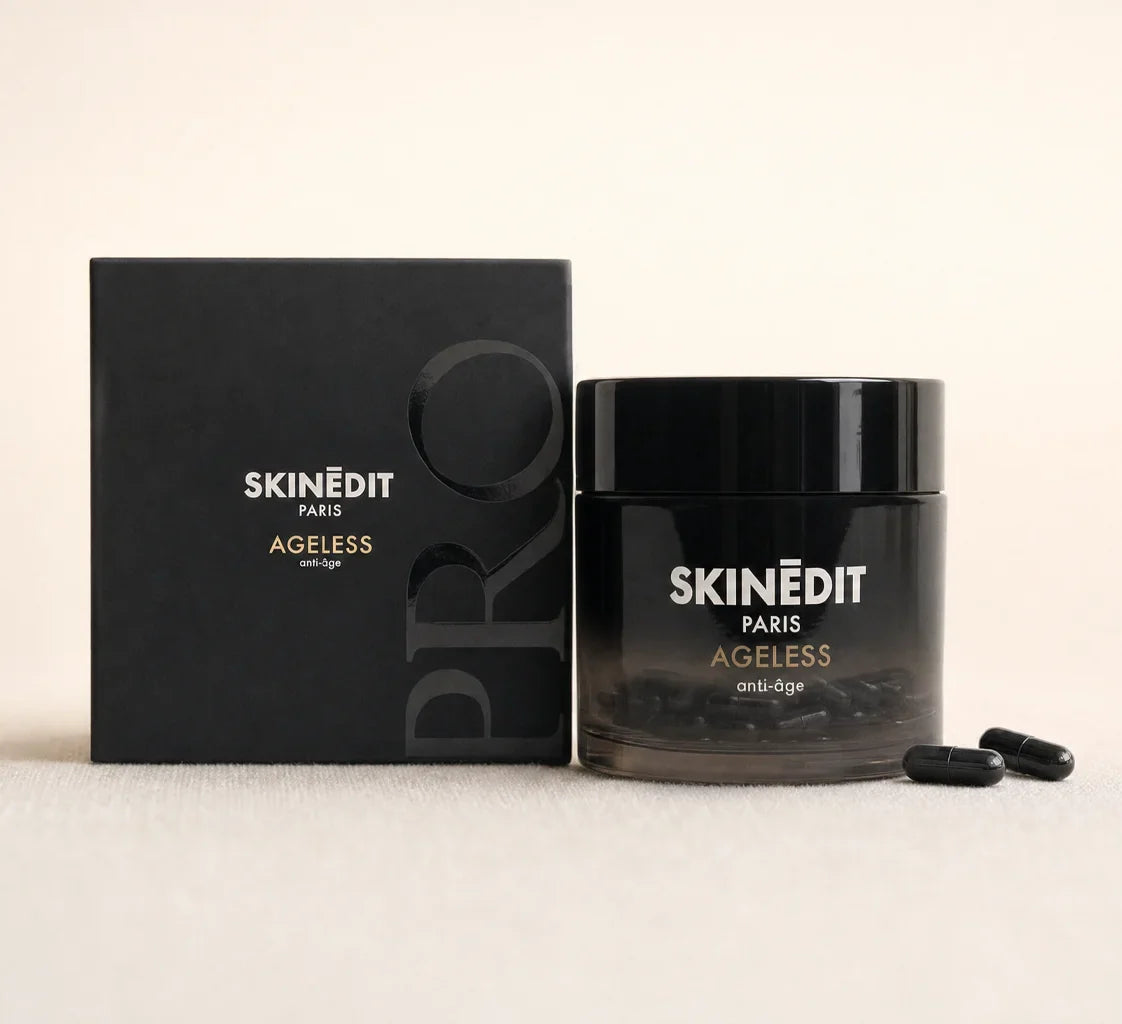
When retinol feels too harsh, another serum is not your only option. SKINĒDIT offers an ingestible approach to the beauty routine: AGELESS for a focus on firmness, RADIANCE for a focus on complexion. A different route, without applying another active to sensitive skin.
What can I use instead of retinol for sensitive skin?
Start with a gentle moisturiser and daily broad-spectrum SPF 30 or higher. Depending on your goal, niacinamide or bakuchiol may be options to consider, with evidence and tolerability that depend on the formulation. If you prefer not to add another topical active, SKINĒDIT’s ingestible protocols offer a different route within your beauty routine. Choose AGELESS for a ritual centred on firmness, or RADIANCE for complexion. The sections below help you select a format around your priority.
You may have chosen retinol for smoother-looking skin, only to find redness and discomfort taking over your routine. An oral protocol changes the way you approach that routine. It does not expose the skin’s surface to another topical retinoid. That distinction is central to SKINĒDIT’s Deep Skincare approach.
Build your oral ritual around a clear beauty priority, alongside gentle moisturising care and daily sun protection. Choose the complete formula with its ingredients, directions and precautions in mind.
SKINĒDIT: an ingestible route when you want fewer topical actives
Choose a daily capsule ritual built around your priority: AGELESS for firmness and facial contours, or RADIANCE for complexion. Each protocol has its own composition and directions, so you can select the formula that fits your beauty routine.

AGELESS is a collagen-free protocol with its own 90-day COMPLIFE® evaluation: 96.9% of the 32 women who completed it reported firmer-feeling skin. This was an open-label evaluation without a placebo group; individual results vary. RADIANCE brings together BELIGHT³™ and liposomal glutathione in a formula centred on complexion. Two distinct formulas, so your ritual starts with what matters to you.
Explore AGELESS if firmness is your priority, or explore RADIANCE if your focus is complexion. Discover each protocol’s ingredients, research and directions, and choose your daily ritual.
These protocols are beauty supplements, rather than treatments for irritation or substitutes for prescribed retinoids. Check the full formula for allergies, interactions and individual suitability; ask a healthcare professional if you are pregnant, breastfeeding, taking medication or managing a medical condition. Keep SPF and a gentle moisturiser as the foundation of your routine.
When retinol irritates: first, reassess the routine
Retinol belongs to the retinoid family. Retinoids can improve fine lines and uneven pigmentation, but they are not suitable for every skin. Persistent redness or inflammation deserves professional advice, particularly if you have rosacea. Retinoids should not be used during pregnancy. [1]
Stop an over-the-counter cosmetic that burns or stings. If it is a prescribed treatment, contact the prescriber about the reaction and how to adjust it. Avoid immediately adding several new actives. Introducing one product at a time makes it easier to identify what your skin tolerates. [2]
Choose an alternative by concern
Dryness and fine dehydration lines
A moisturiser and daily sun protection are a useful starting point. Choose a broad-spectrum sunscreen with SPF 30 or higher, alongside shade and protective clothing. This foundation remains relevant whether you use retinol, another active or an oral product. [3]
Fine lines and uneven tone: niacinamide
A 12-week controlled study in 50 white women evaluated a moisturiser with 5% niacinamide on one side of the face. It reported improvements in several visible ageing signs, including fine lines and pigmented spots, compared with the vehicle. This is evidence for a particular topical formulation, not proof that every niacinamide serum works equally well. [4]
Considering bakuchiol instead of retinol
A small randomised trial compared 0.5% bakuchiol twice daily with 0.5% retinol once daily in 44 participants for 12 weeks. Both groups improved in measured wrinkles and pigmentation; retinol users reported more scaling and stinging. The trial was small and used different application frequencies. It does not establish that all bakuchiol products equal all retinoids, or guarantee tolerance. [5]
“Natural” is not a safety assessment. Pregnancy, a skin condition or a previous reaction is a reason to ask a clinician about the exact formula rather than rely on an ingredient’s reputation.
What about dark spots or loss of firmness?
A useful routine starts with a precise objective. A spot that persists, a dull-looking complexion and a change in facial contours do not necessarily call for the same approach. Read our guides to vitamin C and dark spots and firming skin without surgery before choosing by an “anti-ageing” label alone.
Three questions before your next purchase
- What is my priority? Choose one concern to assess rather than expecting one product to address everything.
- What was actually tested? Look for evidence on the finished formula, including the participants, comparison and measured outcome.
- Can I use it consistently and comfortably? Follow its directions and assess tolerability before adding another step.
Seek medical advice for persistent or severe irritation. This article provides general information and does not replace an individual assessment.
Sources
- American Academy of Dermatology: Retinoid or retinol?
- American Academy of Dermatology: How to maximise results from anti-ageing skin care products.
- American Academy of Dermatology: How to select anti-ageing skin care products.
- Bissett et al. Niacinamide: a B vitamin that improves aging facial skin appearance. Dermatologic Surgery, 2005.
- Dhaliwal et al. Prospective, randomized, double-blind assessment of topical bakuchiol and retinol for facial photoageing. British Journal of Dermatology, 2019.

Firmness begins with a deeper understanding.
Curious about the formulation behind AGELESS? Explore its selected ingredients, the thinking behind their combination and the daily ritual.
Firmness begins with a deeper understanding.
Curious about the formulation behind AGELESS? Explore its selected ingredients, the thinking behind their combination and the daily ritual.
Intelligence is the editorial journal of SKINĒDIT PARIS, exploring skincare, ingredients and the evidence behind beauty routines.
About the author