What is the best supplement for melasma? No single supplement is established as the best treatment. Small trials suggest that specific pine-bark and Polypodium leucotomos extracts may add benefit to a routine that already includes sunscreen and topical treatment. Glutathione has broader pigmentation research, but its melasma-specific benefits remain uncertain. The most useful starting point is a confirmed diagnosis, daily light protection and a treatment plan suited to your skin.
If your goal is a more even-looking complexion, choosing what deserves a place in your routine can be confusing. This guide explains what the research can tell you about oral supplements, then considers how a combined formula might fit alongside your skincare.
Why melasma needs its own evidence
Melasma usually appears as patches on both sides of the face, often across the cheeks, forehead or upper lip. It can persist or return after improvement. A dermatologist can distinguish it from sun spots, post-acne marks and other causes of uneven pigmentation. [1]
A supplement study is most relevant when it enrolled people with diagnosed melasma and measured a melasma outcome. An improvement in general skin lightness or an isolated dark spot does not establish the same benefit for this condition.
For the wider category, see our guide to supplements for hyperpigmentation and their human evidence.
Why sunscreen comes before supplements
Both ultraviolet and visible light can worsen melasma. The American Academy of Dermatology recommends daily broad-spectrum, water-resistant sunscreen with SPF 30 or higher, alongside shade and protective clothing. A tinted sunscreen containing iron oxide adds visible-light protection. Reapply during outdoor exposure and after swimming or sweating according to the product’s directions. [2]
In a randomized melasma trial, sunscreen covering UV and visible light produced better results than UV-only protection when both groups also used hydroquinone. This was evidence for the combined regimen, rather than sunscreen replacing every other treatment. [3]
Which oral supplements have been studied for melasma?
The distinction below is between melasma trials, broader pigmentation research and biological rationale. These options have not all been compared directly with each other.
| Oral option | Evidence relevant to melasma | Main limitation |
|---|---|---|
| French maritime pine bark: Pycnogenol® | A 60-day placebo-controlled trial in 44 women with melasma found additional improvement alongside tinted sunscreen and a topical triple-combination cream. [4] | It tested a particular extract as an addition to treatment, not pine bark alone. |
| Polypodium leucotomos extract | A 12-week Singapore pilot study investigated its addition to hydroquinone and SPF 50+ sunscreen in Asian patients with melasma. [5] | Some clinical assessments favoured the extract, but not all measurements showed a clear advantage. The study was small. |
| Oral glutathione | A 2025 review reported improvements in pigment measurements across oral studies. [6] | Study quality varied; general skin-lightening findings do not establish reliable control of diagnosed melasma. |
| Grape–licorice–vitamin C blend | Two trials studied the defined formulation BELIGHT³™ in facial dark spots and hyperpigmentation. [7] [8] | These were not melasma trials. The 2023 study excluded participants identified with melasma. |
| Vitamin C and other antioxidant combinations | Biological roles may explain ingredient selection, and some combinations have pigmentation studies. | Mechanisms and combination studies do not prove that each ingredient independently treats melasma. |
What does the pine-bark trial actually show?
The randomized trial in 44 women compared oral Pycnogenol® with placebo while keeping tinted sunscreen and prescription triple-combination cream in both groups. After 60 days, the extract group had greater improvement in the modified Melasma Area and Severity Index, a clinical score of the extent and darkness of melasma. [4]
This supports a possible additional benefit within that treatment routine. It does not establish the same effect for another pine-bark extract or a different finished formula.
What about Polypodium leucotomos?
Polypodium leucotomos is a fern extract studied for photoprotective and pigmentation-related effects. A trial at Singapore’s National Skin Centre recruited 40 patients with melasma; 33 women were included in the final analysis. Both groups used hydroquinone and sunscreen, with the extract or placebo added for 12 weeks. [5]
Some clinical scores suggested an additional benefit, while instrumental pigment measurements did not clearly distinguish the groups. The pilot was industry-sponsored and small, so its findings warrant cautious interpretation. It provides a reason for further research, not evidence that an oral supplement replaces sunscreen.
Does glutathione help melasma?
A systematic review published in 2025 found promising oral pigmentation results alongside mixed study quality and uncertainty about how long benefits last. A reduction in a melanin reading is not automatically evidence that recurrent melasma has been controlled. [6]
There is also insufficient direct comparative evidence to call liposomal glutathione the best form for melasma. Absorption data and visible clinical outcomes answer different questions.
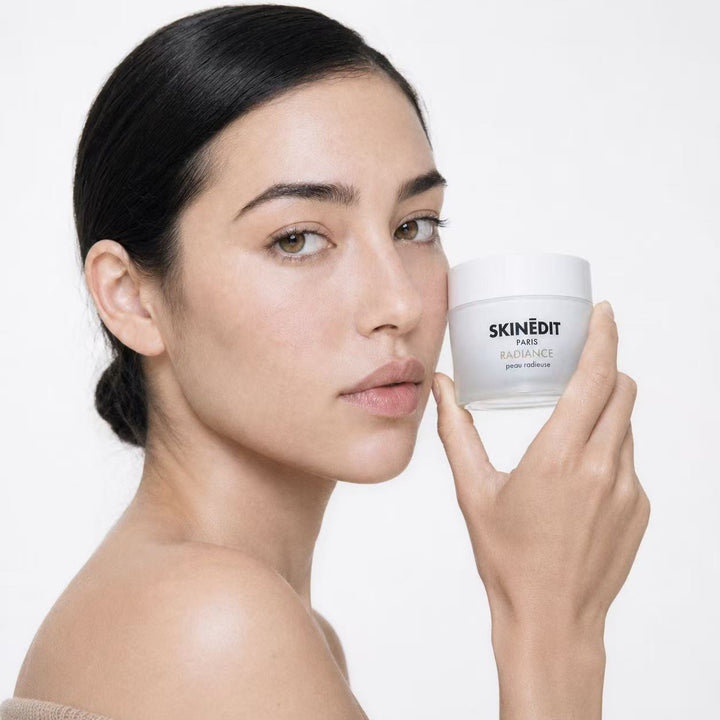
Glutathione is one of the ingredients we selected for RADIANCE, SKINĒDIT’s daily protocol for uneven tone. Its place within the formula reflects our interest in both pigmentation research and antioxidant biology.
How relevant are dark-spot studies to melasma?
The defined grape–licorice–vitamin C blend was studied in two 12-week trials involving 58 Asian and 66 Caucasian adults. These trials concerned facial dark spots or hyperpigmentation; the first excluded people identified with melasma during screening. [7] [8]
Those findings can inform pigmentation research and ingredient selection. They cannot be presented as proof of a melasma treatment. Likewise, the blend’s often-quoted 84.9% tyrosinase inhibition was a laboratory enzyme result, not a percentage reduction in human melasma. [7]
Why RADIANCE brings these ingredients together
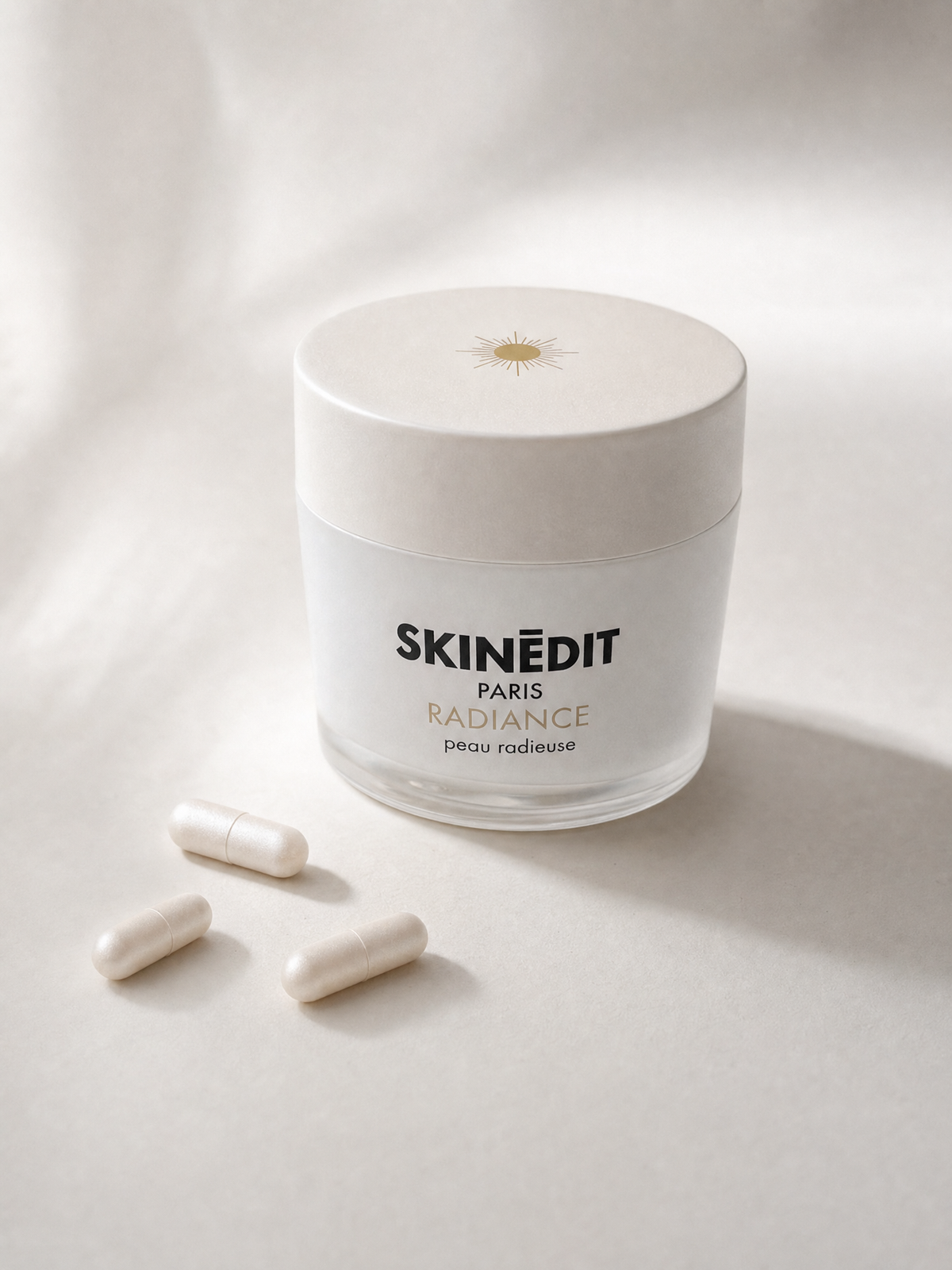
The research raises a practical question: how could an oral formula fit into the routine you already follow? RADIANCE is SKINĒDIT’s nutricosmetic protocol developed around dark spots, uneven tone and complexion clarity.
It brings together BELIGHT³™—the grape–licorice–vitamin C blend discussed above—with liposomal glutathione, L-cystine, selenium and selected botanical ingredients. The formulation connects pigmentation research with antioxidant biology. On the RADIANCE page, you can explore why each ingredient was selected and how it fits within the complete formula.
Its daily ritual is simple: two capsules each morning with food. The 90-day protocol gives that routine a consistent framework; it is not a promised deadline for visible results.
The ingredient studies discussed here are not clinical trials of finished RADIANCE for melasma. RADIANCE is positioned as complementary pigmentation support alongside daily photoprotection and appropriate topical or dermatological care.
Pigment · Signal · Oxidative Stress
Explore why RADIANCE combines BELIGHT³™, glutathione and selected antioxidants—and how its morning ritual is designed around your goal of a more even-looking complexion. Discover the formula, its ingredient evidence and the routine in one place.
Is oral tranexamic acid a melasma supplement?
No. Oral tranexamic acid is a medication used off-label for melasma under medical supervision. It has melasma-specific clinical research, but suitability requires assessment of medical history, contraindications and blood-clot risk. It should not be self-selected as a beauty supplement. [1] [9]
How should you choose a supplement if you have melasma?
- Confirm the diagnosis. Similar-looking marks do not necessarily have the same cause.
- Prioritise melasma-specific research. Check whether the trial studied diagnosed melasma, general skin colour or isolated dark spots.
- Check the full study routine. Was the supplement added to sunscreen, hydroquinone or another topical treatment?
- Match the studied material. Ingredient identity, daily amount and the finished formulation all matter.
- Assess suitability. Discuss supplements with your clinician or pharmacist, particularly during pregnancy, breastfeeding or when taking medicines.
A longer ingredient list does not establish a better result. Our introduction to nutricosmetics and their evidence explains how to compare product claims.
How long do melasma supplements take to work?
The pine-bark and fern-extract studies above evaluated changes over 60 days and 12 weeks, respectively. Those study endpoints are not a promise that melasma will resolve within three months.
Melasma treatment often takes months, and maintaining improvement can require ongoing care. Track your whole routine and compare photographs in consistent lighting. If topical treatment and a supplement start together, a photograph cannot show which caused the change. [1]
Frequently asked questions
What is the best supplement for melasma?
No universal best supplement is established. Selected extracts have small trials as additions to sunscreen and topical treatment. The relevant question is whether the exact product has credible evidence for diagnosed melasma and is suitable for your circumstances.
What evidence supports RADIANCE for melasma?
RADIANCE’s ingredient selection draws on pigmentation studies and biological rationale. The studies cited here did not test finished RADIANCE in people with diagnosed melasma, so they do not establish it as a melasma treatment.
Is liposomal glutathione better for melasma?
Direct comparative clinical evidence would be needed to establish that. A delivery system’s effect on absorption does not by itself prove better melasma outcomes.
Can oral vitamin C clear melasma?
The evidence reviewed here does not establish oral vitamin C alone as a reliable melasma treatment. Results from multi-ingredient formulations cannot isolate its contribution. See vitamin C and dark spots for the broader evidence.
Can a supplement replace sunscreen?
No. An oral product does not provide the same protection as applying sunscreen. Daily UV protection remains central, with iron-oxide-containing tinted sunscreen offering additional visible-light protection. [2]
Can melasma come back after it fades?
Yes. Melasma can recur, so improvement should be followed by an appropriate maintenance routine. A short supplement trial cannot establish permanent clearance. [1]
Related reading
- How to fade dark spots from the inside out
- Topical vs ingestible skincare: how the approaches differ
References
- American Academy of Dermatology. Melasma: diagnosis and treatment.
- American Academy of Dermatology. Melasma: self-care.
- Castanedo-Cazares JP, et al. Near-visible light and UV photoprotection in the treatment of melasma. Photodermatology, Photoimmunology & Photomedicine. 2014;30:35–42. Read the sunscreen trial.
- Lima PB, et al. French maritime pine bark added to triple-combination cream for facial melasma: a randomized trial. Journal of the European Academy of Dermatology and Venereology. 2021;35:502–508. Read the pine-bark trial.
- Goh CL, et al. Polypodium leucotomos extract for melasma in Asian skin: a placebo-controlled pilot study. Journal of Clinical and Aesthetic Dermatology. 2018;11(3):14–19. Read the Singapore pilot study.
- Sarkar R, et al. Glutathione as a skin-lightening agent and in melasma: a systematic review. International Journal of Dermatology. 2025;64:992–1004. Read the glutathione review.
- Pouchieu C, et al. Oral formulation and skin lightening: laboratory testing and a randomized trial in Asian participants. Cosmetics. 2023;10:143. Read the 2023 dark-spot study.
- Tursi F, et al. Clinical efficacy of Belight3™ on dark spot pigmentation in Caucasian subjects. Cosmetics. 2025;12:27. Read the 2025 dark-spot study.
- Liang R, et al. Tranexamic acid for melasma by different administration methods: systematic review and network meta-analysis. Journal of Cosmetic Dermatology. 2024;23:1150–1164. Read the medication review.
About this article: SKINĒDIT publishes this article and makes RADIANCE. The article distinguishes melasma trials, general pigmentation research and ingredient rationale. It provides educational information, not an individual treatment prescription. Persistent or changing pigmentation should be assessed by a qualified healthcare professional.


Jaouad Bentaguena is the founder of SKINĒDIT Paris. He researches and writes the SKINĒDIT Intelligence journal himself — working from peer-reviewed literature and alongside the scientists and clinical partners behind each protocol, to translate deep skin and hair science into something clear enough to act on.
About the author