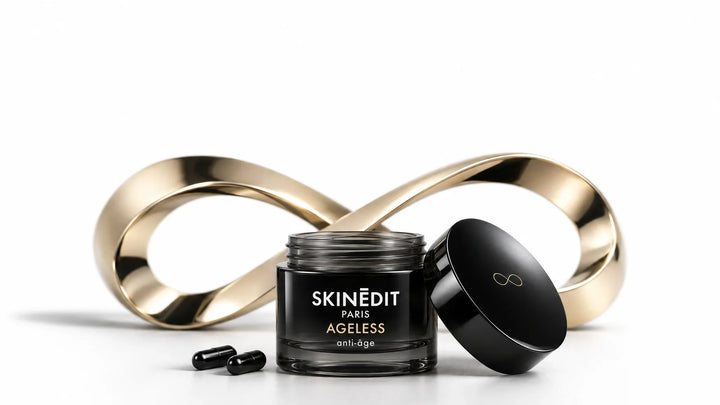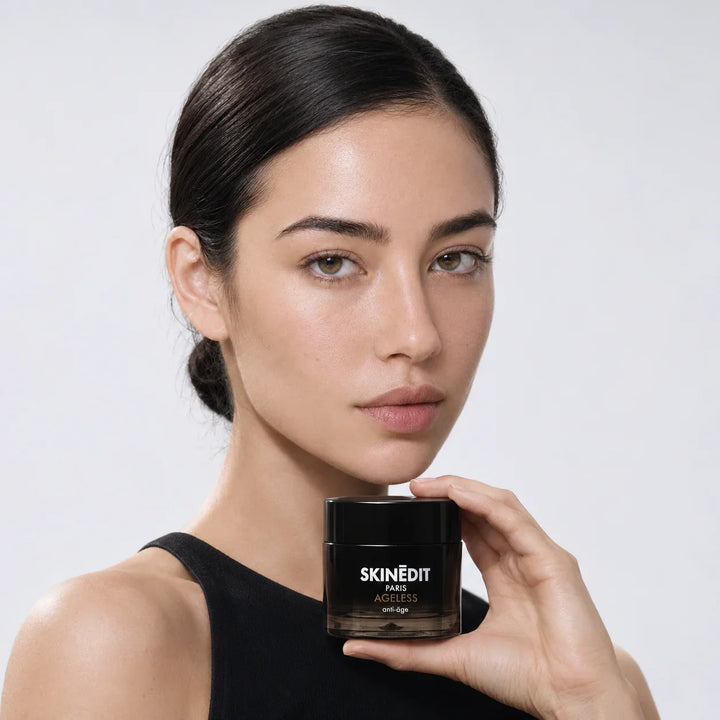
CoQ10 brings a well-researched ingredient to the beauty ritual, in creams and in oral formulas. In AGELESS, SKINĒDIT combines CoQ10 with other selected ingredients in a collagen-free protocol centred on firmness and facial contours. Discover the research on each format and the 90-day evaluation of the complete AGELESS formula.
Coenzyme Q10 appears on both skincare labels and supplement labels. If you already use a Q10 cream, should you add an oral formula? If you prefer a capsule, can it take the place of your serum? A useful answer starts with what each study actually tested.
By SKINĒDIT PARIS, the maker of AGELESS, a multi-ingredient oral formula containing CoQ10.
What is coenzyme Q10?
Coenzyme Q10, also written CoQ10 or Q10, is naturally present in the body. It has roles in cellular energy production and antioxidant biology. In cosmetics, you may see the name ubiquinone on the ingredient list. Those biological roles explain research interest; they do not by themselves prove a visible anti-ageing result from a particular cream or capsule. [1] [2]
What does the research show for a Q10 serum or cream?
A 2015 study by Knott and colleagues investigated Q10-containing topical formulas using laboratory work and a human study. The human component enrolled 73 women and tested a cream and a serum containing different concentrations of Q10 on the forearms. It reported increases in skin quinone levels and antioxidant-related effects. [2]
These findings document topical delivery and antioxidant-related biological activity, rather than facial lifting. The study did not compare topical and oral Q10. Some researchers were employees of a skincare manufacturer.
For your topical step, consider the finished formula’s human results, concentration, stability and texture. A richer cream can bring moisturising comfort; a lighter serum may fit more easily beneath your moisturiser. Choose the format you enjoy using consistently.
What does the research show for oral CoQ10?
A randomized, double-blind, placebo-controlled study in 33 healthy adults tested a water-soluble CoQ10 formulation, Q10Vital®, at 50 or 150 mg daily for 12 weeks. It reported smoother skin and reductions in selected wrinkle and microrelief measures. It did not find significant changes in skin hydration or dermal thickness, or in the tested UV-response threshold. [3]
This small trial concerns Q10Vital®, rather than AGELESS. Its doses describe the research and are not personal dosing recommendations. AGELESS has a separate evaluation of its complete multi-ingredient formula, detailed below.
For context on other ingredients and outcomes, our firmness and elasticity evidence guide compares the wider category without treating all supplements as equivalent.
Why you cannot compare a serum percentage with a capsule dose
A topical percentage describes the concentration in a formula applied to the skin. A capsule label describes an amount swallowed. They use different routes, and neither number tells you the amount that reaches a particular skin layer or produces a visible effect.
There is no reliable conversion that makes a given cream concentration equivalent to a given oral dose. Higher numbers do not establish better results. A comparison also needs the exact form of Q10, the formulation, the duration and the endpoint, not just the ingredient name.

Where AGELESS fits in a CoQ10 skincare routine
AGELESS contains CoQ10 as part of a collagen-free, multi-ingredient formula. It offers an oral step for people considering a routine focused on firmness and facial contours. It should be evaluated as that complete formula, rather than as a replica of a single-ingredient CoQ10 trial.
AGELESS underwent an independent 90-day COMPLIFE® finished-product evaluation: 91% of the 32 women who completed it reported more defined facial contours. Thirty-three women aged 35–60 enrolled. The evaluation was open-label, without a placebo group; individual results vary. [4]
The AGELESS evaluation concerns the complete formula. Ingredient studies explain the formulation choices; the finished-product evaluation describes the experience and measurements recorded with AGELESS itself.
Look at the complete formula
Discover why CoQ10 sits alongside other selected ingredients in AGELESS, and review the finished-product evaluation in full.
How to choose without adding unnecessary steps
- Start with your existing routine. If a cream suits your skin, an ingredient name shared with a supplement is not a reason to stop it.
- Define the outcome. Skin comfort, surface smoothness and facial sagging require different expectations.
- Ask for product-specific evidence. Check whether the research tested the formula you are considering or only a related ingredient.
- Keep sun protection. Antioxidant language is not an SPF rating. Neither topical nor oral Q10 replaces sunscreen.
- Check medicines and overlapping supplements. Adding a second oral product can duplicate ingredients without evidence of extra benefit.
Safety: oral and topical products need different checks
The US National Center for Complementary and Integrative Health notes that oral CoQ10 may cause mild digestive symptoms or insomnia, may interact with warfarin and insulin, and may be unsuitable with some cancer treatments. Discuss oral supplementation with a qualified clinician if you take medication or receive treatment. [1]
For AGELESS, follow the complete product’s precautions, including seeking medical advice during pregnancy or breastfeeding and when taking anticoagulants. A multi-ingredient product needs a review of all its ingredients. For a topical product, follow its directions and stop use if it causes irritation.
Frequently asked questions
Is a CoQ10 supplement better than a Q10 cream?
The studies discussed here do not establish a winner. They used different formulas, routes and outcomes. Choose according to your goal and the evidence for the actual product.
Can I use both?
They can form part of the same routine if each is suitable for you. Added efficacy from combining them has not been established by the studies reviewed here.
Does CoQ10 replace retinol?
Shared anti-ageing positioning does not make two ingredients equivalent. If retinol irritates your skin, see our guide to alternatives for sensitive skin rather than assuming Q10 reproduces its effects.
Does oral CoQ10 protect me from the sun?
It is not a substitute for sunscreen, clothing or shade. The oral trial discussed above did not find a significant improvement in its tested UV-response threshold.
Sources
- NCCIH: coenzyme Q10, background and safety.
- Knott A, et al. Topical treatment with coenzyme Q10-containing formulas improves skin’s Q10 level and provides antioxidative effects. BioFactors. 2015;41:383–390. Read the topical study.
- Žmitek K, et al. Dietary coenzyme Q10 and skin parameters: randomized, placebo-controlled, double-blind study. BioFactors. 2017;43:132–140. Read the oral study.
- AGELESS: formulation, evaluation summary and precautions. Brand-provided finished-product information.
Individual results vary. Food supplements do not replace a varied, balanced diet and a healthy lifestyle. For the wider picture, read topical versus ingestible skincare.

Intelligence is the editorial journal of SKINĒDIT PARIS, exploring skincare, ingredients and the evidence behind beauty routines.
About the author