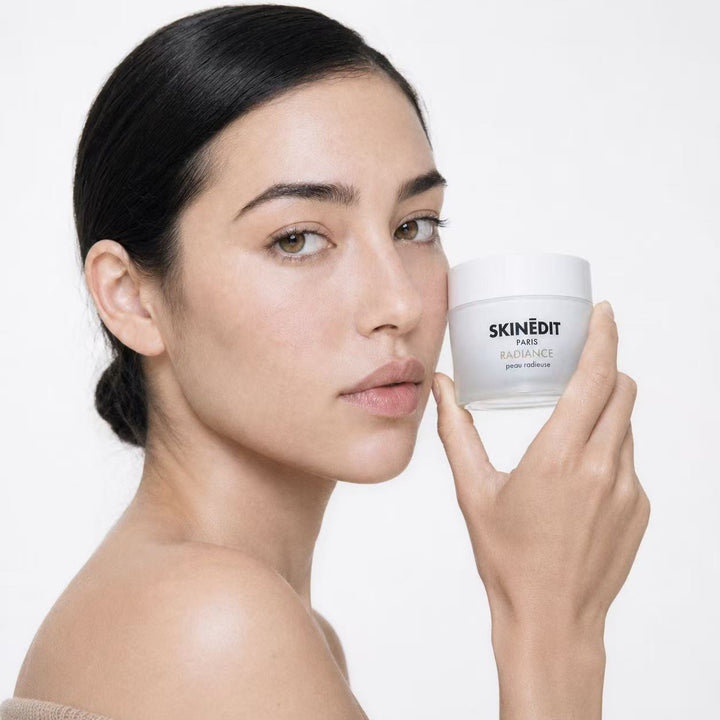
Deep Skincare is SKINĒDIT’s approach to supporting skin and hair from within, alongside topical care. It begins with three concerns—firmness, complexion clarity and hair vitality—and examines the biology behind each before considering an oral formulation. The name describes our approach; it is not a medical category or a measure of how deeply a product penetrates.
A softer facial contour, a persistent dark spot and a widening parting may appear at the same stage of life. They still raise different questions. Understanding those differences is the starting point for AGELESS, RADIANCE and REVIVAL.
What does Deep Skincare mean?
For SKINĒDIT PARIS, it means looking at the processes that help produce what we see: the skin’s supporting matrix, the production and distribution of pigment, and the follicle that forms each hair.
It also means considering how care fits together. Nutrition supplies the body with materials and cofactors for normal physiology. Sunscreen, moisturisers and appropriate treatments retain their own roles. An oral product earns its place through the relevance of its formulation and evidence.
Nutricosmetics is the broader category of oral beauty products. Deep Skincare describes how SKINĒDIT approaches that category: a specific concern, a considered formula and a clear explanation of what supports it.
What does “the other 99%” refer to?
The phrase comes from SKINĒDIT’s original way of drawing attention to biology beneath the visible surface. It is a metaphor, not an anatomical percentage. It does not mean creams reach only 1% of the skin or that supplements reach the remaining 99%.

Oral ingredients undergo digestion, absorption and metabolism; they are not sent selectively to the face. Topical effects depend on the active and formulation. For the practical comparison, read topical vs ingestible skincare.
Which biological processes shape visible beauty?
Structure: the skin’s supporting matrix
The dermis contains a network of collagen and elastic fibres. Cells called fibroblasts help maintain this extracellular matrix. Nutrients have defined roles here: vitamin C, for example, is a cofactor in collagen formation.[1] That physiological role does not establish that taking extra vitamin C will lift a face.
Firmness also needs to be distinguished from facial volume and tissue position. A change in skin hydration or elasticity is a different outcome from restoring lost volume. Our guide to why skin sags in your 40s and 50s explores the wider picture.
Pigment: how colour is made and distributed
Melanocytes produce melanin within structures called melanosomes. In the epidermis, pigment is transferred to neighbouring keratinocytes, helping shape skin colour and its distribution.[2] This biology is distinct from the collagen matrix.
For SKINĒDIT, complexion clarity means considering uneven tone and visible contrast while respecting the skin’s natural colour. The question is how a formula relates to pigment biology and oxidative processes, with photoprotection remaining part of the routine.
Root: where the visible hair begins
A hair fibre is formed within a living follicle. At its base, the dermal papilla communicates with surrounding cells and helps regulate hair growth and cycling.[3] Fibre quality, shedding and progressive thinning are related observations, but they are not interchangeable outcomes.
This is why a hair formula needs its own rationale. For a closer look at the biology, explore the dermal papilla and its role in hair growth.
How does that biology become a formulation?
A mechanism is a starting point. The next questions concern the actual material: its identity, form, daily amount, supporting research and place within the whole formula.
A vitamin’s established function, a laboratory experiment and a controlled human trial each provide different information. Combining ingredients does not automatically combine their study results. This distinction lets you examine the thinking behind a protocol without mistaking a formulation explanation for a promised outcome.
Discover the formulation behind your concern.
Firmness, complexion clarity or hair vitality: begin with what matters to you. Explore AGELESS, RADIANCE and REVIVAL, the ingredients selected for each, and the daily routine that brings the formula into your life.
Why does SKINĒDIT have three protocols?
Separate formulations make their intended roles easier to understand. They also let you begin with one priority.
AGELESS: the formulation behind firmness
AGELESS organises thirteen actives through AGX-3™, NanoLift™ and MitoGen-9™. These names describe its formulation systems around mineral and structural physiology, the dermal matrix, and cellular energy and antioxidant defence.
Discover AGELESS, its complete formula and finished-product evaluation. The guided AGELESS presentation offers a visual exploration of the thinking behind it.
RADIANCE: the formulation behind complexion clarity
LumiTech 5™ organises RADIANCE’s formulation around pigmentation, signalling and oxidative processes. Its components include a defined grape-based complex, glutathione, L-cystine and complementary actives. The interest lies in their selected roles within the complete formula.
Explore RADIANCE and the LumiTech 5™ formulation. The guided RADIANCE presentation connects complexion, light and formulation in more detail.
REVIVAL: the formulation behind hair vitality
KeraSyn™ organises REVIVAL around follicular signalling, fibre construction and supporting nutritional roles. Pea-sprout extract, a keratin-based complex and selected nutrients sit within that design. Understanding these roles helps distinguish care for the follicle from care for the visible strand.
Discover REVIVAL and the KeraSyn™ formulation. The guided REVIVAL presentation takes you through the follicle, its signals and the hair fibre.
What evidence supports the approach?
Deep Skincare describes a formulation philosophy. Evidence must still be assessed for each ingredient and finished product.
For example, the complete AGELESS formula underwent an independent 90-day COMPLIFE® evaluation: 33 women enrolled and 32 completed. It included instrumental measurements and participant self-assessments. The evaluation was open-label and single-arm, without a placebo or parallel control; changes observed during it cannot establish how much improvement the product caused.[4]
RADIANCE and REVIVAL present research on selected ingredients separately from finished-product evidence. Names such as LumiTech 5™ and KeraSyn™ describe how the formulas are organised; they do not turn ingredient studies into trials of the complete protocols.
For help interpreting study results, read do beauty supplements work?
How can Deep Skincare fit into your routine?
Begin with the concern you want to understand. Explore the relevant formula, its evidence and directions, then consider whether it adds something useful to your existing care.
Keep sun protection, suitable skincare, balanced nutrition and any prescribed treatment in place. Review the complete ingredient list for allergies, overlapping supplements and medication considerations. Seek professional advice before use during pregnancy or breastfeeding, or if you take medicines or manage a medical condition. Persistent or unexplained hair loss also deserves assessment.
A regular daily habit is easier to evaluate than a constantly changing routine. SKINĒDIT uses a 90-day reference horizon, but skin and hair do not share one renewal clock. The AGELESS evaluation lasted 90 days; that duration is not a promise that every person or protocol will produce a visible change by day 90.
Frequently asked questions
Is Deep Skincare an established medical term?
Here, it is SKINĒDIT’s name for its approach to skin and hair care from within. It is not a diagnosis, medical specialty or standardised measure of treatment depth.
Is Deep Skincare the same as nutricosmetics?
Nutricosmetics is the broader category of oral beauty products. Deep Skincare describes SKINĒDIT’s approach to designing and explaining formulas for firmness, complexion clarity and hair vitality.
Do I need to take all three protocols?
No. Start by exploring the protocol relevant to your priority. If you are considering several products together, review the combined ingredients and daily amounts before deciding on a routine.
Can Deep Skincare replace my creams or treatments?
No. Oral formulas have a different role from sun protection, moisturising and prescribed treatments. Assess an addition against your own concern and existing care.
Related reading
- What are nutricosmetics?
- Topical vs ingestible skincare: which works better?
- Why does skin sag in your 40s and 50s?
References
- Pullar JM, Carr AC, Vissers MCM. The roles of vitamin C in skin health. Nutrients. 2017;9:866. Biological context; not a trial of a SKINĒDIT product.
- Lambert MW, Maddukuri S, Karanfilian KM, et al. The physiology of melanin deposition in health and disease. Clinics in Dermatology. 2019;37:402–417.
- Morgan BA. The dermal papilla: an instructive niche for epithelial stem and progenitor cells in development and regeneration of the hair follicle. Cold Spring Harbor Perspectives in Medicine. 2014;4:a015180.
- SKINĒDIT PARIS. AGELESS: published summary of the 90-day COMPLIFE® evaluation. Manufacturer-published summary of an independent, open-label, single-arm finished-product evaluation.



Jaouad Bentaguena 是 SKINĒDIT Paris 的創辦人。他親自研究並撰寫 SKINĒDIT Intelligence,從同儕審查文獻出發,並與各協議背後的科學家及臨床合作夥伴交流,把皮膚與頭髮的深層科學轉化成清晰、可理解的知識。
關於作者